Showing posts with label Organise Internet. Show all posts

Tuesday, December 8, 2015

Make 2016 the year The Cloud works for you

We've heard so much about Cloud Computing over the last 4 years that this weird term has quickly become a part of our vernacular. Everything digital is increasingly "in the cloud".  How can we make it work for us?


Your photos are likely on Apple's photo storage site, your address book is up there too, via your phone. Gee even your relationships and private opinions are most likely archived in FaceBook's cloud for you.

If you think about it all of this has kind of happened without us making much of a decision about it.

Perhaps it's now time to do a little thinking about "The Cloud" and what you want in it, what you don't want in it and how it could work for you.

The most obvious advantages of the cloud are the ability to access your work from anywhere with an internet connection. The other being your ability to be able to share your work with others.
Both these features of cloud computing open up a world of flexibility in how a business works.

You can easily have people work from home or outsource a task to someone by giving them access to your cloud systems for the period of their engagement. This alone can vastly reduce costs.

Cloud systems are however very reliant on reliable broadband connections that are fast and inexpensive. While this is available to many people, it is still an issue for many locations. Fortunately most cloud systems now have phone apps that allow you to do your business on your phone.

One of the most robust and useful of cloud systems is now called Google Apps for Work - This is very similar to Google's free versions delivered through gmail. The difference is you can operate all through your own domain name instead of Google's. You also get a higher storage capacity for documents in this paid version.

The pricing is reasonable at between $10-15 per month per email account. Which is very similar to Microsoft's own cloud app offering.


Wednesday, March 25, 2015

The Internet of Things - you are such a thing

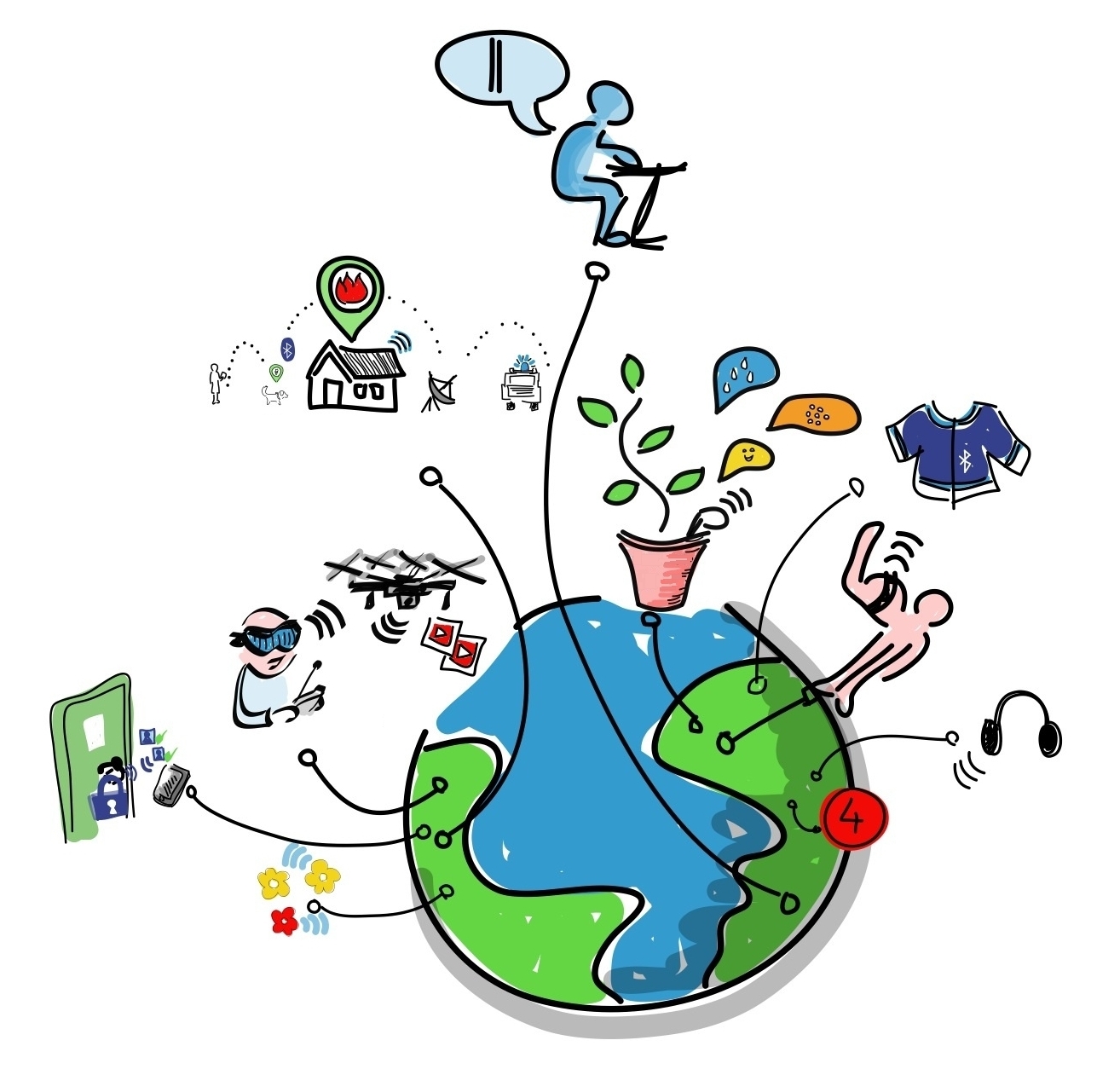
You may have heard a little about The Internet of Things, or not. You will however start to realise that you are one of those things. And those things are many...
The Internet may have been around in it's most basic form since 1969 though it was not until the launch of the World Wide Web and the wide spread use of email that use of the internet became common place. Since then a bewildering set of useful applications and systems have been built on the top of the Internet Protocol or IP for short; mobile apps, interactive maps, smart phones and video streaming to name but a few. IP has been incredibly useful, so useful that we constantly need to revise the expansion of the network and allocate new capacity across the system. It's constantly tempting to think that the growth of the internet is at least slowing down. Social media growth appears to have slowed itself down now.
Wiki Commons licence 
Though each time we assume things will settle down off pops a new popular usage. The latest massive expansion is the internet's takeover of television etc. Services such as NetFlix and YouTube are simply big pointers in a video streaming revolution that is changing entertainment, education and communication industries. TVs are in other words now part of the internet in just same way as phones, computers and gaming consoles.
Though if you stop and observe the Internet landscape you'll see that books (eBook readers), cars (onboard navigation), tickets (electronic transport and entry tickets), toys (networked action figures), credit cards (PayWave systems) are increasingly part of the Internet. All of this on top of an array of identification systems like passports, drivers licences, toll roads and access passes etc. Though too we may realise that our news, sport and entertainment are already deeply part of the internet. Every article you read or view or listen to are on the net and when you consume them your profile is attached to the internet in much the same way as you are tagged in a photo on social media.
Many people are tracking their health and activity using fitness loggers and smart watches, these too connect to the internet.
You may now begin to feel that you are indeed a central part of the internet, though of course all these things that you are connected to don't really need you to work. They talk to each other without you! Your viewing statistics of a particular genre of YouTube cat videos does not need you to inform advertisers to suggest cute products that you are likely to purchase next time you are in the supermarket. This is metadata and it's potential of being used is quiet extraordinary.
In the deep end of The Internet of Things there are particularly more sophisticated things happening than I've mentioned here. Specialised sensors, devices of all sorts and databases are all being connected to each other over the Internet. Indeed if you can imagine a use, it's probably been or being done. Imagine too how you can be part of this evolution.
The Internet of Things has included you some time ago, it maybe time to start wising up to how you may want to include it :)


Monday, July 14, 2014

What's Google My Business ?

Google has launched a bold strategy to get more businesses listed online. This has got to be a good thing, right. There are many out there that really need help. Apparently more the 50% of Australian businesses don't have a website. This is a problem, a problem for everyone really, not least of all the search giant and your business. If Google listings are a problem for your business now's the time to think about this over a nice cuppa tea.

Though at first sip by golly Google is burning the lips of many existing clients. A new interface, automatic upgrades and mixed messaging methods don't help. Highlighting again, how the young recruits at Google lack a little real world experience, particularly of the small business sector.

Of course who could complain, these tools are 'free' after all? Free as in 'free to use', not as in "free beer". Sure it may take you a week to work out and you run the risk of really messing up your listings but stick with it and you'll succeed. (Google recruits take note: Time is the most precious resource for a small business owner - even before an important upgrade).

My Business Image
Google asks "Playing hard to get?" - Many businesses are.
Yet we think it's all worth the effort. The system amalgamation is a natural development in the constantly evolving space of cloud based tools that the big G offer. So what do you get for your effort?

What you get is a simplified and streamlined dashboard for all vital business info; map location, phone numbers, domains, contact hours, services, product categories and the like. The sort of thing that should be available on your website, right? We understand that you may be too busy with clients to make this information handy online. Google have done a lot of the work for you. They've even created  Android and iPhone apps to help you keep everything at your finger tips. Go check it out, you be the judge, grab a cup of tea and contemplate Google My Business, we think you'll be glad you did.


As always if you need a little help, contact a certified Google partner agency. They're trained and motivated to help you get ahead, our listing's below :
A certified Google Partner Agency


Wednesday, June 18, 2014

TimeSlotStudio - We're building a very special broadcast ready studio for you

Creating video in a timely and straight forward manner is still a challenge for most organisations. There are so many considerations; lighting, audio, microphones, makeup and video formats. Not to mention all the camera work and script writing. It's no wonder many professional people find it way too hard to make a serious start.

That's why some of our friends we asked us to build a studio for customers and their clients. The concept we've worked up is "Walk in Walk out" - everything set up, everything ready to use; cameras, audio, lighting and props and broadcast - thanks to our incredibly fast NBN fibre networks.

Digital Dave gives a quick technical test of the studio - 
We've invested heavily in great networks and computers to allow you to broadcast or narrowcast your content in real time. This can be used for a lecture, a lesson or a musical performance. Importantly it can be used to help monetise your productions on a subscription or pay per view basis.

While our technical investments are up and working now, we have a vision of a greater studio. A infused with the 1960 and 1970s - the era of so much change. The era of the birth of the internet, video recording and amazing creativity.

We're commencing our own crowd funding campaign to make our studio something extra special for our partners, customers and their clients.

We've created a broad array of rewards for our crowd funding campaign - from full production series, exclusive T-shirts, and a special 60' / 70's themed cocktail party and much in between.

Get involved in our Pozible powered Crowd Funding program here:
Web: www.organise.net.au/TimeSlotStudio
YouTube:
https://www.youtube.com/user/timeslotstudio
FaceBook:
https://www.facebook.com/TimeSlotStudioTV
Twitter:
https://twitter.com/TimeSlotStudio
Tumblr:
http://timeslotstudio.tumblr.com/
Instagram:
http://instagram.com/timeslotstudio

Come on board - join our mission to give you to best digitally leveraged AV studio on the East Coast of Australia.
Instagram

Monday, February 3, 2014

Social Business - New Retail

Opening an online store can be a protracted nightmare. At least if the experiences of an increasing amount of novice retailers are anything to go by. Here's one example of how one woman overcame design dramas and geek speak to profit from her experience.

Susan had been in retail for about a decade, founding a successful suburban store on the outskirts of Sydney, Australia. She had style and friendliness and her shop was well located with plenty of parking. Weekend trade was brisk and busy, which made Monday and Tuesday her functional weekend when she opened late and put on staff.
Credit: Sofiaperesoa via Wikimedia Commons

Increasingly she picked up loyal customers who kept asking if they could shop online when new things arrived. She had some success in Facebook likes, though it stopped there. Susan was aware of the retailing trends moving online. She remembers being struck by how many billion dollars her countrymen were spending on online as a wakeup call.

She had a website, yet it was little more than a brochure, map and telephone listing. Being a bit of a perfectionist she hesitated at first, knowing that to set up an online store required thoughtful planning and needed to reflect the look and feel of her physical boutique. Her perceptions were right!

She had her graphic designer sketch up a fresh look, it didn't quiet fit. They tried several times and after many weeks reluctantly came up with a design based around her other favourite online stores.
Next step was to engage with her website host, asking them to "make it happen". She received quotes and questions in various forms, but most of all she felt uncomfortable dealing in terms she didn't know much about. Payment gateways, shopping cart engines, search category listings, postage calculations, terms and conditions and web ready design all became part of the conversation. She sent the design and was told it was not 'web ready' and would have to be done again. Her favourite fonts were not suited to the web either. All would have to be reworked. Ahh...

Days turned into weeks, weeks into months and at last an online store was ready to launch when disaster struck. Her website and online shop hosts merged with another company and she lost her contact. Worse they took the site down due to an accidental billing irregularity. Ahhhhh...
Weeks of phone and email battles ended in her moving the website and online store to another company that salvaged most of the previous work and simplified the billing systems.
The new online company was calm and factual, always keeping her expectations reasonable and her plans on target. She reckons it's cost her 120 hours of work and about $15,000 cash, something she thinks she could almost halve a second time around. Interestingly that's about what it cost to do the first fit out of her physical store.

Her online store is now a functioning and attractive system that is steadily attracting leads and sales. She writes a brief monthly newsletter, utilises Google Adwords advertising, FaceBook posts, a regular blog with Twitter and Instagram feeds. All of which keeps the social conversation going and does drive people back to her stores, both online and the beautiful shop front business.
The way things are tracking it would have paid for itself in 6 months despite being a real headache. Everything is not perfect, she relies on receiving monthly reports with suggestions from her trusted online partner OI. The future does look bright however. Her store is turning into a valuable business asset with increasingly healthy cash flows attached. Susan's business nightmares are about other things now. Her online store's a pleasant dream :) zzzz.

'Susan' is a pseudonym. She's a customer of OI: organise internet - Organise Internet has been helping build profitable online businesses since 2002. OI is a certified Google Partner and a member of NORA - National Online Retail Association of Australia.

NOTE:
OI: Organise Internet is holding an exclusive event dubbed 'New Retail - how to thrive selling online' Guest key note speaker is Paul Greenberg, co-founder of DealsDirect and Chair if NORA - supporting speaker Danis Tandiono Certified Google Adwords expert. 9am, March 3, 2014 in Gosford.


Monday, January 6, 2014

Australia's Gigabit Genie out of the bottle - entrepreneurs smiling

A growing group of Aussie change makers and entrepreneurs are sick of Australia being known as a dirty big mine. They've sniffed the dusty air, rubbed a magic lantern and come up with another way. The Gigabit Genie has awakened!
Last month the nation's new broadband company NBNCo quietly switched on fibre based gigabit services to their wholesale service providers reports ZDnet . 2014 could indeed be the start of a magical year for entrepreneurs.

Original entrepreneurs

The wide brown land in the south has always been full of resourceful people. The original inhabitants survived and thrived in what is a land of extreme heat, cold, rain and drought. Leading them to be some of the great survivors of the planet. Today's aboriginal Australia is entering a sort of renaissance via art works, music, sport and business pursuits.
To the early european settlers in the late 18th century the adaptable and flexible ways of the aboriginals was apparent in their subtle use of fire to stimulate pastures and raise game on very marginal soils. Indeed, together with innovative fishing techniques this seems to have lead to the survival of the early colony of Sydney.

Fleet fingered innovators

The convicts and settlers of the day were by definition a fleet fingered and "entrepreneurial" bunch and many quickly adopted innovative ways of surviving and later thriving in the tough countryside. Over 220 years later Australia is one of the worlds wealthier nations after overcoming the odds of climate, isolation and a burdened cultural heritage.

Unlikely farming success

Paradoxically, agricultural produce was the the first major export of the nation and wool was the prized commodity. Australia is said to have rode on the sheep's back for many decades and still has a sizeable part of the world fine wool market. If you wear a good suit, chances are that it's from an Aussie merino sheep. Though wool is but one export, Australia grows every crop known to civilization, from native macadamia nuts to rice, cotton and wheat.

Aladdin's cave for Prospectors 

Though the nation's mineral resources were the sleeping giant, if only they could be transported. Distance was a the great challenge. Vast territory needed to be covered to get minerals to market. Yet slowly the mines, railways and the ports were built and what started out as a trickle is now a massive flow of iron ore, coal, bauxite, gold, diamonds, uranium, gas and almost every mineral know to man. While American 'black gold' seekers where striking oil, media shy Australian prospectors were busy uncovering some of the greatest mineral deposits on the planet. Now the largest mining companies in the world are Australian, or at least nominally as they are owned by many happy shareholders. The world's wealthiest woman too is an Australia heir of a flamboyant mining prospector *.

Time for the next boom

Yet as is so often the case with massively profitable industries they tend to distort their host economies and to some extent the bend the politics of the nation in their favour. Resulting in an artificially high exchange rate, a skills drain from other industries and a general wage pressure. All very well if you're involved in the mining industry either as a supplier, shareholder or employee. Pretty crappy if you're not. Most of Australia is not.
Many resourceful Aussies are starting to ask "surely there's another way to make a buck down under". Turns out there is.

Digital boom 

Increasingly there's evidence of a new boom tied to digital technologies thanks in no small part to an audacious plan to build a nationwide fibre optic network capable of gigabit speeds in the short term and terabit speeds in the foreseeable future. The National Broadband Network or NBN was partly an economic answer to the global economic crisis but has quickly gathered huge support as an alternative economic and entrepreneurial driver of the future. All this despite a recent change of government that threatens the extent of the project. In many ways the threat of divestment has hardened the resolve of many that will fight for the project and more importantly for the business opportunities in a digital economy quickly evolving around the globe.
Interestingly the current footprint of the NBN fibre optic networks is predominantly in outer metro and regional Australia where the old copper networks were in poor condition. This is having the result of making these locations highly attractive to entrepreneurs looking to leverage the use of such amazing bandwidth for services.

New entrepreneurs

Australia is already a disproportionate contributor to the successful digital economy with winners like Invoice2go & Play2Lead and a proud history in the assisted development of the internet protocol TCP/IP, WiFi, Google Maps in addition to big successes in early computing history.
Now the entrepreneurial zeal of previous generations coupled with emerging gigabit networks it seems the land down under may just overcome the odds and the tyranny of distance once again. These new entrepreneurs having rubbed the proverbial magic lantern of the NBN, are conjuring up a new digital boom time. Bigger, better and brighter than Aladdin's gold mine, quiet literally.

NB: The author  of this article is actively involved in several enterprises researching the use of gigabit networks. Planning on distributing findings, products and services as they come online. Interested in investing, researching or building a product or service? Make contact!


Monday, December 9, 2013

Elephants and strippers love bitcoin

The internet has always been an elephant in most board rooms. It's big, popular, sometimes ugly and very energetic. The internet elephant uses more bandwidth than all the financial sector put together. Grows faster than a gold mine and adopts radically new business forms every few years. Though one nut the internet has found hard to crack is a simple universal micro payment method. Until now. The digital economy may just about to become turbo-charged.


A relatively new way we can feed jumbo is with a virtual currency and early indications show it's working a treat.

As is so often the case online, look to the online sex industry for an answer to a challenge.
Interestingly the digital porn industry has been suffering from it's own popularity. There are more terabytes dedicated to erotica that anything else. More importantly once a photo or film is taken it's replicated easily by hundreds of others who increasingly dilute the market and drive down the value of a "popular body of work". So much so that most 'bodies of work' are now free. The only commodity left is 'live' shows. These are strip shows where the viewers can login after paying, then 'chat' with the performer, who can choose to interact or ignore the heated banter. How though does the performer get paid?

Enter the challenge of quick, fast and relatively anonymous online micro payments.
Bitcoin and it's sister virtual currencies have recently gained a foothold, fast becoming seriously popular and useful. In the case of live shows it makes good sense to quickly transfer an entry fee to the performer and watch for a fixed time. This is happening too in the live online gaming space with platforms like Twitch.TV broadcasting live games to interested viewers around the world.

It's relatively easy to set up a Bitcoin wallet, there are several providers out there - once you've set that up you have a unique address to send payments to and of course ways to send requests to a bitcoin currency exchange to cash them out in 'real money'.

With the US reserve accepting that Bitcoin is now a semi-legitimate currency isn't time to feed the elephant with virtual 'nuts'. Weird, perhaps but it's happening and growing in popularity.

The author makes no apologises for using such huge, nutty metaphors about elephants. Instead he strongly suggests a small online payment to:


Images are used under a Creative Commons licence via WikiCommons.org from their respective owners. Click on images to view sources.

Monday, November 11, 2013

Lorde: A Weather Vane for Social Media Culture

A 16 year old New Zealander, Lorde has shot to unprecedented popularity in the global music race recently, topping the US & UK charts. She's a phenomenon that may be a much broader weather vane, signalling a wind of change in the online world. Challenging one of the founding tenements of the current pack of social media platforms; love of self. If so, teenagers like Lorde will again lead change as in the 50s & 60s.

There is evidence in Lorde's poetic song texts that indeed she may be heralding a major shift in our explosive interest in self focussed social media. If the popularity of of her online downloads and messaging is anything to go by this young woman may have pointed out one of those great shifts in online behaviour. One towards a desire for a more constructive, collaborative online reality.

Image of Lorde
Lorde. A weather vane? Pic by Thatboyrion

Lorde, AKA Ella Yelich-O'Connor is a particularly astute representative of her generation, in her own words she's no white teeth teen. A lover of poetry thanks to her mother and of music thanks to her father seems to have provided the ideal environment for a positive artistic questioning of the popular paradigm.

Her first & incredibly popular album named the double entendre 'Pure Heroine' is laced with strong subtexts that the(her) digitally native generation is tiring of looking at glam bang social media posts & ads.
Forbes magazine journalist Liv Buli (@lbuli), a specialist in online data analysis of the music industry published a revealing insight into Lorde's popularity last month in @Forbes. In it she cites an explosive weekly download from Sound Cloud of 825,000 for one song on the album Royals. A song with a strong generational critique of contemporary glamour culture with words like ".. That love just ain't for us, we crave a different kind of buzz" and "My friends and I have cracked the code". There seems to be an emerging commitment to working together for something more real, more satisfying in her texts.

Maybe her prophetic words "We're on each other's team" is a deeper cry for people to work together collaboratively rather than endlessly shout and brag to each other through contemporary social media sites.

Whether her honest observational song lines are game changing influences like Bill Haley's '54 recording of Rock Around the Clock is a matter for the future, Lorde's early popularity suggests she may very well be. It is possible that in being supercharged by today's internet world, her change could be more influential and spread more quickly than in the 50s & 60s.

The internet with it's ability to connect people together certainly can spread cultural change quicker than at other times in history. The internet constantly seems to surprise us. Who would have imagined a FaceBook or a YouTube being a billion people strong in such a short time. Or that Social Media would be a part of national revolutions. Though pretending that the online world will always look the way it does at the moment is foolhardy at best.
Lorde's "I'm kinda over being told to throw my hands up in the air" and "all my fake friends and all of their noise" or "Maybe the internet raised us" taps into a feeling for change in the way teenagers perceive things. Perhaps in much the way teenagers of the 60s used the music of their age to change the prevailing culture.

If the seeds of change are germinating online we should not expect to predict it with specifics. Instead we should be ready for the change by reading the shifting winds, expecting to find the signs in unusual places. Perhaps in the musical poetry from teenagers is a place to keep an eye on.

I'm not sure of the exactness of the sort of changes that will happen, yet there's a sense of a new examination of reality and how the internet can help better reflect that. It's early days, though research & development that OI's been conducting point to a desire emerging of a more collaborative context. A context that creates a more satisfying online reality. Granted a new reality may seem impossibly small as I write. The all consuming strength of FaceBook, YouTube & Twitter are pervasive.

To paraphrase Lorde's song Still Sane "I maybe little but I'm coming for the crowd". That crowd may very well be turning toward a renewed online reality as her songs suggest. If that is the case we've all got a lot to look forward to from her generation and the online tools that they will use.

In the mean time download and/or listen to Pure Heroine

Dave Abrahams
@digitdave - @OrganiseInt

5M4GBK7NY8T5

Sunday, October 20, 2013

Data download heading skyward

You'd think that we'd had enough of downloading data, it seems that we've just started...

Freshly analysed data by OI from the Australian Bureau Of Statistics has found that in the 6 months from December 2012 to June 2013 Australia's data consumption rose  18%, making the annual data download growth rate over 30%.
"This is a staggering rate of growth that everyone in business should take note of" says Dave Abrahams, Principal Consultant at Organise Internet. "To put this in perspective if you had 30% more people walking through your business premises in the last 12 months you'd probably start rejoicing and investing in ways to meet the demand" .
With the debate still raging about broadband infrastructure investments this incredible dataset may help guide the background assumptions.It seems growth in this sector of the economy has only just started to be realised.


Media commentary can be organised by contacting via twitter @OrganiseInt or by contacting Organise.net.au directly via their website.


Tuesday, October 1, 2013

Search Gravity rules revealed

Search Gravity™


When Isaac Newton founded his ideas about gravity under the apple tree little did he know that in the new cyber world the same rules would apply.

While 'gravity' may seem a strange way of approaching the impact of your online assets. It's one of those concepts that makes more sense the more you work with it.

OI Organise Internet's successful search methodology is focussed around the realities and rules of online gravity. "We've been developing this methodology for 10 years now and it works. The methodology helps us keep ahead in the often shady world of SEO" Says Dave Abrahams, Principal Consultant of OI Organise Internet an specialist Australian search innovation firm.
Clearly the firm isn't going to reveal it's latest innovations it is keen to spread the word about their  research & development.

The first rule of Search Gravity™ is about QUALITY. 

We make clear to all our clients that when they are building assets in cyber space they need to be quality assets, everything from websites, Social media, videos, blogs needs to be good quality. Using dodgy tricks to attract hits, likes etc simply ruins your online reputation and effectively acts like anti-matter. Likewise poor marketing efforts degrade your organisation, poor grammar and oversized images have negative effects too. Quality is the magic formula of the building gravity in cyber space. Quality differentiates you from the space junk and white noise out there online.

The second rule of Search Gravity™ is about creating MASS.

To use an obvious pun "It's not rocket science" to create online or cyber mass. It is however difficult to achieve in any organisation. Competing agendas and diverse responsibility chains make the task a challenge. You really need to establish common links and reference rules .This will sew together an organisation's assets and not tear them apart. For example when the Marketing department launch a new Social Media campaign they may be inadvertently diluting your online mass by creating parallel offerings. "We see this a lot in our business" says Abrahams "Many campaigns have different names and syntax to the original product or service. The names may seem cool but they play into the hands of competitors who can take over a top search ranking".

Rule three of Search Gravity™ is about Attraction & Acquisition

Just like any aspiring planet you need to attract mass to get bigger. In the cyber world this can be facilitated by partnering with organisations that not only link to your offerings; blogs, product specials or campaigns but also apply the quality and mass rules that you've created previously.
"We often negotiate on behalf of clients with third parties for positive cyber partnerships. Naturally it's up to the clients to sign off on the partnerships but more often than not this works out to be mutually beneficial" says Dave "In some cases we've even started partnerships that lead to mergers or buy outs"

These are OI's three rules of creating Search Gravity™. Sure they are not the sort of thing that NASA will be adopting anytime soon but gee they are an easy way to conceptualise, organise and report to clients. We're developing new tools and techniques all the time that use these metrics and methodologies. Feel free to talk to us about advanced ideas or campaigns.

Thursday, July 25, 2013

Stop Complex - Simple Cloud productivity

Administration and compliance getting you tied up? Most modern people would answer yes to this and if they were involved in doing business they would most likely scream YES YES!

Recording what you do and why you're doing it has become an unfortunate default model for a modern world. Just noting down your car trips can become a major drag on your energy and potentially on your productivity. And to what end does all this recording and data collection do? A good question indeed, something we won't go into here, but to say that it can be good to have if and when things get sticky.
Most of us could indeed do a lot more with less reporting though the reality is we're going to have to change that over time.

One classic and true formula is to take a hit stick to your administration with the use of some high tech. Map out your necessary compliance and admin tasks and get creative about collecting the data, archiving it and creating reports. Once you've done this you'll feel a little more comfortable about organising the data into flows.

Now's the time to visit a complex solutions expert like Organise Internet . We'll use your map to suggest brave new ways to collect your data, archive it, process it and report on it. Typically we can halve administration time and therefore deliver significant productivity dividends. 

Apprenticeships at school


One major client in the training and education field has drastically reduced the amount of time used to organise and report on apprenticeships and traineeships in the state of NSW in Australia. The sbatjobs.info system has also improved the quality of reporting and compliance for this important sector of the state's skilled education training system helping increase the retention of young people in trade training contracts.

Solutions cloud


"The job of organising an apprenticeship for a young person while still at school is difficult, it involves parents, employers, schools and trade training institutions not to forget the apprentice themselves. The legalities and duty of care is significant and the 'paperwork' is a small nightmare. The sbatjobs system has vastly streamlined the process and improved the reporting. In fact most of the paperwork is done by the system" says Danis senior web engineers  at Organise Internet.

The processing system behind the scene has made the once complex task of organising and reporting on the progress of a apprentice or trainee a straight forward and well reported task.

This example is a classic solution of Complex to Simple , something that classic well designed and managed cloud solutions can help solve.

Make contact with us to steer you in the right direction...


Thursday, May 23, 2013

Follow the Money: making money online is more than being 'liked'

"Follow the money"! Have you heard the catchphrase?
It was popularised in the film All the Presidents Men back in the 70's as commentary to the Watergate corruption scandal of the same decade.
We can use the same method to easily assess the success or otherwise of any online investment. It's a little brutal, however ultimately, any website, social media presence or app development will be measured by this blunt yardstick. "Money talks BS walks" to coin another catchphrase. Having a profile online and being 'liked' is only a start.

Though we understand that most businesses get online just to profile themselves, perhaps to list a few products and services and have their address and phone number published... just 'to be there' as it were. Yet in a maturing online space this is really not enough.  In other words your investment needs to yield some return. 

We read of super geeks making millions and home bound parents managing huge online stores turning over millions. We read too of bloggers replacing newspapers and teenagers selling their gaming accounts for more than their parents earn all year. A grain of salt should be applied to the most extreme stories. People do however make good money online. We have clients that have gone from zero to hero in 6 -12 months.

How? Connect your bank account!

So how on earth can "I" make money online, I hear you cry.  The short answer is that you need to connect your website, social media presence, app, video etc. to your bank account. It really is as straight forward as that. Not simple, but straight forward.
In our experience you need to make a plan and then work it.
It's worth talking to people that can help you professionally in this space, people that have done it before and know the not inconsiderable trapdoors. Find someone that you can trust to work up a plan and then give them the job of assembling the team and services that are required, in other words appoint a team leader. Don't fall into the trap of having different people do bits of the job for you and expecting them to work together seamlessly. They rarely will.


Most importantly you'll need to give yourself a budget for the project and empower your team leader to deliver on time and within budget for the investment. With the right team and approach you'll be able to follow the money into your business bank account without the fuss of a WaterGate :).


Thursday, May 2, 2013

Is your CMS a hand brake?

Using a content management system of CMS to manage you organisation's web information is a no brainer, yet are yesterday's CMS really keeping up with your demands?
Content management is such an amorphous term these days, as is the case with so many tech terms CMS has become an anagram with it's own life. The CMS has joined such capitalised giants like OS , SMS, FTP & PC. The CMS used to do what it stood for, 'managing content', simple, easy to understand and a great step forward from direct coding of html. The CMS used to be a small miracle too, in that it opened up the editing of online content to an army of new players to use and publish. Content expanded massively as a result, as witnessed by blogs and wikis. Content production exploded! Indeed it could be argued that today's social media systems are simply great big CMS with some pepper and spice thrown in. Revealing the publisher's long held secret that people love news and  people love an audience, even if it's their own 'virtual' audience.
These days you can sign up and grab a free CMS from a myriad of open source or commercial sources. Weird and wonderful names such as Drupal, Joomla, DotNetNuke, Liferay and Moodle have established footholds in their geography of the internet. WikiPedia, itself a BIG CMS lists dozens of CMSs. WordPress indeed has become de rigour on the web as a open source industry in it's own right. With the ever promising 'template' producers selling a million look and feels (strangely never quiet what we're looking for).

Though as we've discovered over the years a CMS is only a starting point to an online strategy it's not an end point!

From humble CMS to Super CMS

A CMS can be also be a full business process re-engineering tool. It can be the basis for everything from customer feedback and reporting to an intranet style form replacement for tablet of mobile computing. More advanced functions that allow complex data flow or financial calculations can harness the use of cloud computing. Then a CMS can be used to closely integrate with your existing internal or external data systems.

Fast, Flexible Alternative to off the shelf

OI has been researching and developing it's CMS Syntara for 6 years as a alternative to off the shelf CMS packages. It's been built for extreme flexibility of use, enabling it to effectively become an innovation platform without the full expense of a pure coded application.


A team of developers and business analysts are constantly improving and developing Syntara through the latest technology research and feedback from the pool of trusted clients. What other system is improved on a weekly basis with upgrades and updates happening automatically? Features of Syntara include:
• control: full add/ edit/ view/ delete control over all data records
• usability: search, quick-find, backup and restore
• integration: full import/ export capabilities, links into your existing website, can integrate into your current PC-based systems
• website: full WYSIWYG editors, email, website and performance statistics, file upload and an image library
• communications: integral email and SMS communications, post, scheduled communications, and complete transaction logs
• administrative: reporting, concurrent users, multiple user permissions levels
• calendar: with weekly and month activity views, transaction and activity logs, task and project scheduling
• secure: firewall and IP restrictions, user passwords and definable access levels
• invoicing: sending via email or post, scheduled and automated invoicing and payment reminders, recurring billing, and MYOB / Xero integration
• Streaming video or video on demand integration
• Full cross device interoperability - tablet, phone of specialist device.
• Plus more… with much more to come.

If your CMS is not keeping up with your demands, it may be worth considering a transition to a secure, fast and flexible system such as Syntara.

Sunday, March 24, 2013

Telework in small business - our experience

How can telework or flexible work practices work for small workplaces. Our business Oi: Organise Internet has now been trialling telework for a year. Gosh, we even stuck our necks out and became the subject of a national Telework promotion campaign. (have a look here at our overdone makeup if you're interested: Telework.gov.au)

Three screens may help organise your home office
Multi Screen Telework

Yahoo and Google are great big employers, which ever way you look at it. They reportedly are not fans of staff teleworking any more, at least if recent media reports are to be believed. Apparently some of their managers want people back in the office. The reports cited a need to bump into each other and 'innovate' around the water coolers (does anyone actually have those any more?).
The reaction to those reports as met with amazement in that such a stand seemed counter to the 'work anywhere' discussions that are quite the rage in many workplace HR discussions.

So what was our reality?
Firstly, Google and Yahoo do have a point. Bumping into each other is important, innovating is important and casual encounters are important.
However we've discovered that these important encounters are not going to disappear anytime soon as we only allow telework one day a week. Plenty of time to innovate in the office. One thing I do know is that it does make us a more family friendly employer. For myself and the staff that is important.

Distractions
There are upsides of being away from the office distractions too. Our Technical Manager, a disciplined mature family man is definitely a fan. He reports that he can focus on specific tasks without the "innovating interruptions " of the office of the daily distractions of driving in traffic.
It's worth noting that he has organised a quiet study at home and no one else is at home when he's working from there.

Lampooned
What we didn't see coming was the fun a games of being discussed even lampooned in the national media. We've attracted attention on ABC National Radio & TV and more interestingly on Channel 10's The Project last week.

Not so sexy - good for other reasons
Our small business telework experience is characterised as being all very organised and disciplined, not sexy and cool, as a Google office. There is real value all the same, particularly for families and I would think for reducing traffic jams.

In the work place it's added a new element in more flexible work practices. Work practices that can benefit both employer and employees in small business if structured correctly.


© Copyright Organise Internet