Showing posts with label Search. Show all posts

Tuesday, January 6, 2015

Why search engines are still better than social media

We're all familiar with search engines like Google, Bing, Yahoo or Baidu if you read Chinese. Though Social Media seems to be so much more in vogue. Social interactions and chat are after-all naturally compelling.

Though searching for things is increasingly important in the ever expanding web. Indeed the idea of searching or looking for something has become a necessary part of most modern activities.
Teachers and students 'search' when researching subjects, Journalists 'search' when drafting an article, police search when looking for criminals.  Shoppers 'search' when checking out prices and products. Everyone who's ever been on the internet searches for things, ideas, locations or histories.  Looking around is a natural extension of curious nature.
I like to think of social media as a top level activity, it's wonderful for brand building, customer feedback and research into what competitors are saying. Indeed Social Media is great once you've acquired a customer to keep them engaged with your brand. Though you'll also notice that Social Media platforms are pretty poor at search specific items or companies. Instead it's our collective habit to follow the opinions of friends and some of their associated friends.
Search on the other hand is a validating process for most people. Whether it be a new pair of shoes or and industrial item we are increasingly being active in our research. Geographical searching via Google maps is indeed one of the most popular of Google's search platforms when buying food and larger or more expensive household goods.

Tuesday, October 1, 2013

Search Gravity rules revealed

Search Gravity


When Isaac Newton founded his ideas about gravity under the apple tree little did he know that in the new cyber world the same rules would apply.

While 'gravity' may seem a strange way of approaching the impact of your online assets. It's one of those concepts that makes more sense the more you work with it.

OI Organise Internet's successful search methodology is focussed around the realities and rules of online gravity. "We've been developing this methodology for 10 years now and it works. The methodology helps us keep ahead in the often shady world of SEO" Says Dave Abrahams, Principal Consultant of OI Organise Internet an specialist Australian search innovation firm.
Clearly the firm isn't going to reveal it's latest innovations it is keen to spread the word about their  research & development.

The first rule of Search Gravity is about QUALITY. 

We make clear to all our clients that when they are building assets in cyber space they need to be quality assets, everything from websites, Social media, videos, blogs needs to be good quality. Using dodgy tricks to attract hits, likes etc simply ruins your online reputation and effectively acts like anti-matter. Likewise poor marketing efforts degrade your organisation, poor grammar and oversized images have negative effects too. Quality is the magic formula of the building gravity in cyber space. Quality differentiates you from the space junk and white noise out there online.

The second rule of Search Gravity is about creating MASS.

To use an obvious pun "It's not rocket science" to create online or cyber mass. It is however difficult to achieve in any organisation. Competing agendas and diverse responsibility chains make the task a challenge. You really need to establish common links and reference rules .This will sew together an organisation's assets and not tear them apart. For example when the Marketing department launch a new Social Media campaign they may be inadvertently diluting your online mass by creating parallel offerings. "We see this a lot in our business" says Abrahams "Many campaigns have different names and syntax to the original product or service. The names may seem cool but they play into the hands of competitors who can take over a top search ranking".

Rule three of Search Gravity™ is about Attraction & Acquisition

Just like any aspiring planet you need to attract mass to get bigger. In the cyber world this can be facilitated by partnering with organisations that not only link to your offerings; blogs, product specials or campaigns but also apply the quality and mass rules that you've created previously.
"We often negotiate on behalf of clients with third parties for positive cyber partnerships. Naturally it's up to the clients to sign off on the partnerships but more often than not this works out to be mutually beneficial" says Dave "In some cases we've even started partnerships that lead to mergers or buy outs"

These are OI's three rules of creating Search Gravity™. Sure they are not the sort of thing that NASA will be adopting anytime soon but gee they are an easy way to conceptualise, organise and report to clients. We're developing new tools and techniques all the time that use these metrics and methodologies. Feel free to talk to us about advanced ideas or campaigns.

Monday, August 29, 2011

Google Ranking Algorithm - A Sneak Peek into their Change Process

Online marketers, primarily those that breathe and live Google woke up to a small surprise in the form of a video released by the search engine giant. The video did not reveal how Google actually ranks websites as many news publications out there might be eluding to. It does however confirm how frequently Google updates it's search algorithm and the procedures they take before releasing these updates to the public.

Amit Singhal confirmed that "just last year, we launched over 500 changes to our algorithm. So by some count we change our algorithm almost every day, almost twice over". Scott Huffman, Google Engineering Director, continues by stating that they "analyse each potential change very deeply to try to make sure that it's the right thing for users". He adds, "In 2010, we ran over 20,000 different experiments. All the data from the human evaluation and the live experiment are then rolled out by a search analyst".

This video discusses how Google identifies, tests, and implements tweaks to their algorithm in their quest to server it's users with the best content that they are searching for. As an example, the video then looks at the reasoning and test procedures that affected the "did you mean" and "showing results for" change earlier this year.

Watch the entire video below.


Thursday, April 21, 2011

Mature Approach to Getting Found on Google

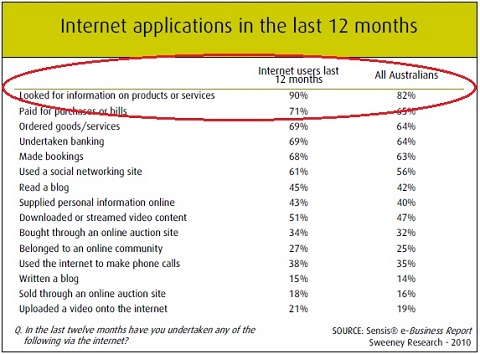
The world of being found is changing quickly. For years now the phone books were a 'must' for businesses of all types, now we're all moving online at an astonishing rate. According to Nielsen, 80.1% of Australia’s population were online in 2010 (= 17.03 million people). A recent Sensis report claimed that 90% of Australian internet users used the internet to look for information on products or services.


Taking into consideration Google’s 94% market share in Australia, we can deduce that 14.41 million Australians have used Google in 2010. That’s almost 68% of the entire Australian population. No other site has this kind of penetration! This represents a rapid growth over the last three years. In fact the latest trend points to a huge increase in using mobile phones for searching for businesses and services, an area Google very keen to expand quickly, and for good reason. A recently published statistics indicate that 41% of all mobile phone users in Australia access the web, with searching for products and services listed as the 4th most popular activity at 56% which represents a 15% increase over the previous year.
Organise Internet has been in THE SEARCH BUSINESS for many years and our accumulated experience is reflected in our mature and practical approach to online developments. Our deep knowledge of other Google products and services really helps navigate this relatively new area of business marketing. So if you're looking at getting found by the people who want to find you, talk to us. We're not script kiddies or back room operators, we know a lot about search and we're happy to help you get the results you're looking for.

Email David or Danis or call us on (02) 4340 5706 and book a low cost briefing session. We're bound to surprise you about the possibilities for those that adopt a flexible mature approach.
© Copyright Organise Internet