Showing posts with label Australia. Show all posts

Monday, August 17, 2015

Who’s to blame when artificial intelligence systems go wrong?

Republished via:

Thursday, April 23, 2015

Be Mobile Friendly or Disappear ? Not entirely


There's been much talk about 'Mobilgeddon' and the new Google rankings adjustment that will rank mobile friendly websites higher than sites that don't render well on mobile devices.

The official Google blog in Australia points out that ranking is made up of approximately 200 factors about your website, not just the ability of mobile users to view your website well. Having said that Google will be ranking websites that are mobile friendly higher than those that do not render for mobile phones for mobile searches. Fair enough, I'd certainly like to have a site that is touch screen and thumb friendly when I'm on my mobile. Google is at pains to remind people that these changes won't affect search rankings on traditional computers.


If ranking is a big deal for your business, you're probably already aware of these changes and have completed the transition to a mobile friendly platform. If not, now's the time to get moving. There are two main ways of achieving this: The first is to entirely redesign your website in a what's called a 'responsive' framework. The second is to create a separate site for mobiles and if necessary create a redirect to the mobile site. Google accepts both ways as legitimate. The first method is a bigger job and suits businesses that where going to upgrade anyway. The second is a quick and effective way to maintain your ranking.

Use this official Google tool to check out how mobile friendly your existing site is. Check here.

Despite all this 'formatting' discussion, our experience is that regular, interesting and relevant content is the best way to boost your website's rankings, and Google would say; a little Adwords advertising helps too :)


Wednesday, November 5, 2014

Gigabit Internet - building the future

Gigabit Cities, Towns & Regions.


Picture a youngster in the future, stooped over a laptop in the back room of a disused shop in a long forgotten country town. Coffee cups, half eaten pastries and the faint smell of last night’s alcohol fills the air. A sad dystopian image so far, but look a little closer.
He’s but one of a dozen people sitting or standing around various bits of old and new furniture. The walls are covered in ultra thin screens, windows into other teams in other parts of the world; China, the US, Norway & Brazil. They’re all working together on something or other, something global, something significantly big. Many languages are being spoken and simultaneously translated in real time. Videos make up part of presentations, audio is being composed to fit, financial documents embedded in the project.
All happening seamlessly, no delays, no pixelation, no distortion no waiting for files to transfer. The sound quality is perfect, the discussion is natural, this is the future of work. And it is entirely built around ultra fast gigabit networks.
All this should not entirely be unexpected, the internet after all has been growing in usage, speed and capacity at an astonishing rate since it became widely commercially available in the early 1990s.


The internet is the backbone of all mobile phone usage, all fixed line usage, increasingly most of radio, TV and movie transmission. Almost all of the worlds financial transactions now occur over the internet and a large part of humanity use it for most of their social and professional communications. Profession after profession is being disrupted and reconstructed in ways that few had seen coming. From education to medicine to shopping and defence, indeed government and governing is slowly being changed by the power of the ubiquitous and always connected world. It is an unstoppable force, fuelled by our collective desire to re-imagine the future in a massively online world. A true wave of change is upon us. Some will ride this powerful wave, others may resist it, others may simply be submerged by it.


It is in this backdrop that a future certainty can be brought into focus. Many opportunities for growth will no doubt be there for those that connect, collaborate and adapt.
One thing is certain though, the faster, more scalable and more reliable our networks are the more opportunities for growth there will be. Gigabit networks will release and liberate wealth, health and wellbeing wherever they are found. In other words the prosperous places of the future will be gigabit enabled cities, towns, regions and nations. It really is that simple and it has started happening now.

Text extract from a speech given to the Fabian Society in Sydney by Dave Abrahams in 2014 - Copyright. Follow the author on Twitter @digitdave
...
Video is a Mashup from the Google Fibre project.

Monday, July 14, 2014

What's Google My Business ?

Google has launched a bold strategy to get more businesses listed online. This has got to be a good thing, right. There are many out there that really need help. Apparently more the 50% of Australian businesses don't have a website. This is a problem, a problem for everyone really, not least of all the search giant and your business. If Google listings are a problem for your business now's the time to think about this over a nice cuppa tea.

Though at first sip by golly Google is burning the lips of many existing clients. A new interface, automatic upgrades and mixed messaging methods don't help. Highlighting again, how the young recruits at Google lack a little real world experience, particularly of the small business sector.

Of course who could complain, these tools are 'free' after all? Free as in 'free to use', not as in "free beer". Sure it may take you a week to work out and you run the risk of really messing up your listings but stick with it and you'll succeed. (Google recruits take note: Time is the most precious resource for a small business owner - even before an important upgrade).

My Business Image
Google asks "Playing hard to get?" - Many businesses are.
Yet we think it's all worth the effort. The system amalgamation is a natural development in the constantly evolving space of cloud based tools that the big G offer. So what do you get for your effort?

What you get is a simplified and streamlined dashboard for all vital business info; map location, phone numbers, domains, contact hours, services, product categories and the like. The sort of thing that should be available on your website, right? We understand that you may be too busy with clients to make this information handy online. Google have done a lot of the work for you. They've even created  Android and iPhone apps to help you keep everything at your finger tips. Go check it out, you be the judge, grab a cup of tea and contemplate Google My Business, we think you'll be glad you did.


As always if you need a little help, contact a certified Google partner agency. They're trained and motivated to help you get ahead, our listing's below :
A certified Google Partner Agency


Wednesday, June 18, 2014

TimeSlotStudio - We're building a very special broadcast ready studio for you

Creating video in a timely and straight forward manner is still a challenge for most organisations. There are so many considerations; lighting, audio, microphones, makeup and video formats. Not to mention all the camera work and script writing. It's no wonder many professional people find it way too hard to make a serious start.

That's why some of our friends we asked us to build a studio for customers and their clients. The concept we've worked up is "Walk in Walk out" - everything set up, everything ready to use; cameras, audio, lighting and props and broadcast - thanks to our incredibly fast NBN fibre networks.

Digital Dave gives a quick technical test of the studio - 
We've invested heavily in great networks and computers to allow you to broadcast or narrowcast your content in real time. This can be used for a lecture, a lesson or a musical performance. Importantly it can be used to help monetise your productions on a subscription or pay per view basis.

While our technical investments are up and working now, we have a vision of a greater studio. A infused with the 1960 and 1970s - the era of so much change. The era of the birth of the internet, video recording and amazing creativity.

We're commencing our own crowd funding campaign to make our studio something extra special for our partners, customers and their clients.

We've created a broad array of rewards for our crowd funding campaign - from full production series, exclusive T-shirts, and a special 60' / 70's themed cocktail party and much in between.

Get involved in our Pozible powered Crowd Funding program here:
Web: www.organise.net.au/TimeSlotStudio
YouTube:
https://www.youtube.com/user/timeslotstudio
FaceBook:
https://www.facebook.com/TimeSlotStudioTV
Twitter:
https://twitter.com/TimeSlotStudio
Tumblr:
http://timeslotstudio.tumblr.com/
Instagram:
http://instagram.com/timeslotstudio

Come on board - join our mission to give you to best digitally leveraged AV studio on the East Coast of Australia.
Instagram

Friday, May 16, 2014

CEBIT 2014 Digital Business report

Australia’s largest and most respected IT conference and expo CEBIT has morphed from a tech industry meet-up to a true digital business/economy event. This year’s CEBIT conference marked their transformation by moving west from Sydney’s Exhibition centre in Darling Harbour to Homebush the home of the successful 2000 Olympics. The move has re-energised the event, now in its 13th year. A revamped offering over 3 days was more about innovation and facilitating business than just geek tech.


Travelling out to Homebush by car was an unnecessary luxury as the train ticket was included in the entry, ( a nice touch and a vote of confidence in the event from the NSW government). My fellow traveller was a prominent business publisher and he’d just taken charge of a wonderful new car from Mercedes. The car has so much technology crammed into it I quickly became his onboard technology advisor.


Belkin, a Central Coast based company greeted us when entering the substantial expo hall. They were promoting their new range of Smart Home technologies; automated networking of all things electrical in the home/office. The pricing points for these once very expensive items are now incredibly digestible and worth a close look.


Beyond the big company stands there was an impressive array of foreign trade stands from China, Germany, India and the UK. Though it was the crafty New Zealanders from Wellington that had the best pitch to my mind. The aspiring Tech City of Wellington had dragged over a bunch of fun business people to talk up their city and NZ as a whole. A mix of good business data, coffee, food and cheeky personalities was winning people over, me included. Wellington fell short on only one count, fibre optic broadband. Something I bragged Gosford had over them. Of course they quickly replied that they were onto it and a full fibre optic rollout to all premises was well on the way.


The conference side of the event was as thorough as always, with so called Big Data, eHealth, Cloud, Mobility and Cyber Security the main lecture themes. Though Paul Budde’s bite sized info sessions proved most popular. Paul heads a Central Coast based global telecommunications consultancy Budde.com which has become a hallmark of CEBIT Australia over the last decade. His experience from around the world helps frame the Australian version of the CEBIT global franchise.


Close to my heart was a fun new concept this year. As startup’s have been on everyone’s lips this year, CEBIT revamped and expanded it’s fun ‘StartUp Alley’ concept. Almost 100 startup projects were present providing the quirky energy and pizzazz that tech expos usually lack. There was a wide range of new concepts waving their idea flags in the wind, all of whom later competed at a pitch fest event. One of the winners was a mob called MathsSpace, that is evolving the teaching of complex mathematics concepts in a very cool and engaging way. Though most of all the Startup alley bought new faces to the event, many young people of course, though notable were less tech looking experienced old hands and most encouraging many more entrepreneurial women.


An honorable mention to the University of Newcastle who were out in force again with their micro robotics students, a specialisation that the UoN are gaining a global reputation for. Their Nubots program was most popular with the crowd. Nubots are programmable 1 foot high robots that can do many things, among other things play football (watch out CC Mariners).


3D printing exhibitors were there in full force. This technology is evolving rapidly and is fast becoming mainstream. The sophistication of items that can be printed now is incredible; bones, complex tools and industrial spare parts among them. The price points for the machines has dropped incredibly and range from a few thousand dollars for basic machines to just $60k for incredibly sophisticated industrial units.
The opportunities these technologies represent to revitalise local manufacturing should not be under-estimated.


CEBIT Australia is now well underway to evolving into the “must visit” event on the Australian/Pacific digital business calendar. I was informed by an insider of the parent company in Hanover, Germany that the Australian franchise, started by Jacquie Taranto is seen as the innovation leader in it’s field. That’s saying something, as if you’ve ever had the pleasure of visiting CEBIT Europe it is a mighty tough gig to beat the Germans at their own expo game.


“Digital” Dave Abrahams
@digitdave

This article appeared in the Central Coast Business Review & on ABC Central Coast Radio 92.5

Monday, February 3, 2014

Social Business - New Retail

Opening an online store can be a protracted nightmare. At least if the experiences of an increasing amount of novice retailers are anything to go by. Here's one example of how one woman overcame design dramas and geek speak to profit from her experience.

Susan had been in retail for about a decade, founding a successful suburban store on the outskirts of Sydney, Australia. She had style and friendliness and her shop was well located with plenty of parking. Weekend trade was brisk and busy, which made Monday and Tuesday her functional weekend when she opened late and put on staff.
Credit: Sofiaperesoa via Wikimedia Commons

Increasingly she picked up loyal customers who kept asking if they could shop online when new things arrived. She had some success in Facebook likes, though it stopped there. Susan was aware of the retailing trends moving online. She remembers being struck by how many billion dollars her countrymen were spending on online as a wakeup call.

She had a website, yet it was little more than a brochure, map and telephone listing. Being a bit of a perfectionist she hesitated at first, knowing that to set up an online store required thoughtful planning and needed to reflect the look and feel of her physical boutique. Her perceptions were right!

She had her graphic designer sketch up a fresh look, it didn't quiet fit. They tried several times and after many weeks reluctantly came up with a design based around her other favourite online stores.
Next step was to engage with her website host, asking them to "make it happen". She received quotes and questions in various forms, but most of all she felt uncomfortable dealing in terms she didn't know much about. Payment gateways, shopping cart engines, search category listings, postage calculations, terms and conditions and web ready design all became part of the conversation. She sent the design and was told it was not 'web ready' and would have to be done again. Her favourite fonts were not suited to the web either. All would have to be reworked. Ahh...

Days turned into weeks, weeks into months and at last an online store was ready to launch when disaster struck. Her website and online shop hosts merged with another company and she lost her contact. Worse they took the site down due to an accidental billing irregularity. Ahhhhh...
Weeks of phone and email battles ended in her moving the website and online store to another company that salvaged most of the previous work and simplified the billing systems.
The new online company was calm and factual, always keeping her expectations reasonable and her plans on target. She reckons it's cost her 120 hours of work and about $15,000 cash, something she thinks she could almost halve a second time around. Interestingly that's about what it cost to do the first fit out of her physical store.

Her online store is now a functioning and attractive system that is steadily attracting leads and sales. She writes a brief monthly newsletter, utilises Google Adwords advertising, FaceBook posts, a regular blog with Twitter and Instagram feeds. All of which keeps the social conversation going and does drive people back to her stores, both online and the beautiful shop front business.
The way things are tracking it would have paid for itself in 6 months despite being a real headache. Everything is not perfect, she relies on receiving monthly reports with suggestions from her trusted online partner OI. The future does look bright however. Her store is turning into a valuable business asset with increasingly healthy cash flows attached. Susan's business nightmares are about other things now. Her online store's a pleasant dream :) zzzz.

'Susan' is a pseudonym. She's a customer of OI: organise internet - Organise Internet has been helping build profitable online businesses since 2002. OI is a certified Google Partner and a member of NORA - National Online Retail Association of Australia.

NOTE:
OI: Organise Internet is holding an exclusive event dubbed 'New Retail - how to thrive selling online' Guest key note speaker is Paul Greenberg, co-founder of DealsDirect and Chair if NORA - supporting speaker Danis Tandiono Certified Google Adwords expert. 9am, March 3, 2014 in Gosford.


Monday, January 6, 2014

Australia's Gigabit Genie out of the bottle - entrepreneurs smiling

A growing group of Aussie change makers and entrepreneurs are sick of Australia being known as a dirty big mine. They've sniffed the dusty air, rubbed a magic lantern and come up with another way. The Gigabit Genie has awakened!
Last month the nation's new broadband company NBNCo quietly switched on fibre based gigabit services to their wholesale service providers reports ZDnet . 2014 could indeed be the start of a magical year for entrepreneurs.

Original entrepreneurs

The wide brown land in the south has always been full of resourceful people. The original inhabitants survived and thrived in what is a land of extreme heat, cold, rain and drought. Leading them to be some of the great survivors of the planet. Today's aboriginal Australia is entering a sort of renaissance via art works, music, sport and business pursuits.
To the early european settlers in the late 18th century the adaptable and flexible ways of the aboriginals was apparent in their subtle use of fire to stimulate pastures and raise game on very marginal soils. Indeed, together with innovative fishing techniques this seems to have lead to the survival of the early colony of Sydney.

Fleet fingered innovators

The convicts and settlers of the day were by definition a fleet fingered and "entrepreneurial" bunch and many quickly adopted innovative ways of surviving and later thriving in the tough countryside. Over 220 years later Australia is one of the worlds wealthier nations after overcoming the odds of climate, isolation and a burdened cultural heritage.

Unlikely farming success

Paradoxically, agricultural produce was the the first major export of the nation and wool was the prized commodity. Australia is said to have rode on the sheep's back for many decades and still has a sizeable part of the world fine wool market. If you wear a good suit, chances are that it's from an Aussie merino sheep. Though wool is but one export, Australia grows every crop known to civilization, from native macadamia nuts to rice, cotton and wheat.

Aladdin's cave for Prospectors 

Though the nation's mineral resources were the sleeping giant, if only they could be transported. Distance was a the great challenge. Vast territory needed to be covered to get minerals to market. Yet slowly the mines, railways and the ports were built and what started out as a trickle is now a massive flow of iron ore, coal, bauxite, gold, diamonds, uranium, gas and almost every mineral know to man. While American 'black gold' seekers where striking oil, media shy Australian prospectors were busy uncovering some of the greatest mineral deposits on the planet. Now the largest mining companies in the world are Australian, or at least nominally as they are owned by many happy shareholders. The world's wealthiest woman too is an Australia heir of a flamboyant mining prospector *.

Time for the next boom

Yet as is so often the case with massively profitable industries they tend to distort their host economies and to some extent the bend the politics of the nation in their favour. Resulting in an artificially high exchange rate, a skills drain from other industries and a general wage pressure. All very well if you're involved in the mining industry either as a supplier, shareholder or employee. Pretty crappy if you're not. Most of Australia is not.
Many resourceful Aussies are starting to ask "surely there's another way to make a buck down under". Turns out there is.

Digital boom 

Increasingly there's evidence of a new boom tied to digital technologies thanks in no small part to an audacious plan to build a nationwide fibre optic network capable of gigabit speeds in the short term and terabit speeds in the foreseeable future. The National Broadband Network or NBN was partly an economic answer to the global economic crisis but has quickly gathered huge support as an alternative economic and entrepreneurial driver of the future. All this despite a recent change of government that threatens the extent of the project. In many ways the threat of divestment has hardened the resolve of many that will fight for the project and more importantly for the business opportunities in a digital economy quickly evolving around the globe.
Interestingly the current footprint of the NBN fibre optic networks is predominantly in outer metro and regional Australia where the old copper networks were in poor condition. This is having the result of making these locations highly attractive to entrepreneurs looking to leverage the use of such amazing bandwidth for services.

New entrepreneurs

Australia is already a disproportionate contributor to the successful digital economy with winners like Invoice2go & Play2Lead and a proud history in the assisted development of the internet protocol TCP/IP, WiFi, Google Maps in addition to big successes in early computing history.
Now the entrepreneurial zeal of previous generations coupled with emerging gigabit networks it seems the land down under may just overcome the odds and the tyranny of distance once again. These new entrepreneurs having rubbed the proverbial magic lantern of the NBN, are conjuring up a new digital boom time. Bigger, better and brighter than Aladdin's gold mine, quiet literally.

NB: The author  of this article is actively involved in several enterprises researching the use of gigabit networks. Planning on distributing findings, products and services as they come online. Interested in investing, researching or building a product or service? Make contact!


Monday, December 23, 2013

SnapChat for Pleasure & Business

What are you talking about? Snap to it...

For the uninitiated SnapChat is an App for your smart phone, officially described as a visual messaging app. It uses video and/or photo accompanied with text that can be sent to a select group of recipients. The best way to think about it is as a visual text message.

However it is the temporary nature of the images that last only for 10 seconds that is the most original function of the application service.

Snapchat logo.png
 Snapchat logo.png*TM

It is very popular among teenagers and twenty somethings that reportedly love the anonymous nature of the communications. Messages abound about it's use in so called 'sexting', where body parts are filmed or photoed and sent to a 'friend' for a peek before disappearing. Some will find this disturbing, others liberating, depending on your age and motivations.

Naturally much speculation has been made about it's use in criminal activity such as threatening behaviour or stake outs of houses or objects. The apparent attractiveness being that there is no evidence of the images left to incriminate anyone.

Can it be used in business of some sort?

We've discovered that SnapChat has the ability to send these images messages to groups and this has been used by some innovative organisations to convey advertising messages or information messages.

If you're looking to differentiate yourself from the mob of social media promotions and wish to target switched on smart phone users then SnapChat is the business.

*TradeMark of SnapChat inc

Monday, November 25, 2013

Teamwork Travel


Travelling in a team can be a bit of lottery with the best of company at the best of times. Many of us will remember fateful school tours to a monument of some significance. Though the memories are often more aligned with the super silly antics of one or two of your fellow students.
Others remember trips with groups of colleagues on business conferences in far flung towns. Chances are the dramas involved leaving people in bus stations or airports, of lost visas or rapidly changing timetables. Where is Jenny !


Though these days you're more likely to be sitting at a free internet kiosk checking in of your FB status. In the mean time your group has taken the mini-bus to the conference centre in the middle of said foreign town.

This is where a little bit of experience in the form of team management software and methods can make a team trip memorable for the impeccable organisation and e'spirit . We've tried all sort of solutions over the years. Mixtures of email, SMS, document vaults and other free SM solutions. Though keeping it all simple was a challenge. Until we came across a tool originally designed for sporting and construction teams. it works on every platform and is easy to include people and assign delegations. It uses the vTeam engine and comes in many flavours.

vTeam software is used by 10s of 1000s of people in all walks of life to keep the groups ticking over on time and on song. Closed and private there's room for documents, videos, links and event calendaring and with the handy teamSMS you'll seldom be out of touch. vTeam takes the lottery out of organising team travel. www.organise.net.au


Sunday, October 20, 2013

Data download heading skyward

You'd think that we'd had enough of downloading data, it seems that we've just started...

Freshly analysed data by OI from the Australian Bureau Of Statistics has found that in the 6 months from December 2012 to June 2013 Australia's data consumption rose  18%, making the annual data download growth rate over 30%.
"This is a staggering rate of growth that everyone in business should take note of" says Dave Abrahams, Principal Consultant at Organise Internet. "To put this in perspective if you had 30% more people walking through your business premises in the last 12 months you'd probably start rejoicing and investing in ways to meet the demand" .
With the debate still raging about broadband infrastructure investments this incredible dataset may help guide the background assumptions.It seems growth in this sector of the economy has only just started to be realised.


Media commentary can be organised by contacting via twitter @OrganiseInt or by contacting Organise.net.au directly via their website.


Thursday, May 23, 2013

Follow the Money: making money online is more than being 'liked'

"Follow the money"! Have you heard the catchphrase?
It was popularised in the film All the Presidents Men back in the 70's as commentary to the Watergate corruption scandal of the same decade.
We can use the same method to easily assess the success or otherwise of any online investment. It's a little brutal, however ultimately, any website, social media presence or app development will be measured by this blunt yardstick. "Money talks BS walks" to coin another catchphrase. Having a profile online and being 'liked' is only a start.

Though we understand that most businesses get online just to profile themselves, perhaps to list a few products and services and have their address and phone number published... just 'to be there' as it were. Yet in a maturing online space this is really not enough.  In other words your investment needs to yield some return. 

We read of super geeks making millions and home bound parents managing huge online stores turning over millions. We read too of bloggers replacing newspapers and teenagers selling their gaming accounts for more than their parents earn all year. A grain of salt should be applied to the most extreme stories. People do however make good money online. We have clients that have gone from zero to hero in 6 -12 months.

How? Connect your bank account!

So how on earth can "I" make money online, I hear you cry.  The short answer is that you need to connect your website, social media presence, app, video etc. to your bank account. It really is as straight forward as that. Not simple, but straight forward.
In our experience you need to make a plan and then work it.
It's worth talking to people that can help you professionally in this space, people that have done it before and know the not inconsiderable trapdoors. Find someone that you can trust to work up a plan and then give them the job of assembling the team and services that are required, in other words appoint a team leader. Don't fall into the trap of having different people do bits of the job for you and expecting them to work together seamlessly. They rarely will.


Most importantly you'll need to give yourself a budget for the project and empower your team leader to deliver on time and within budget for the investment. With the right team and approach you'll be able to follow the money into your business bank account without the fuss of a WaterGate :).


Sunday, March 24, 2013

Telework in small business - our experience

How can telework or flexible work practices work for small workplaces. Our business Oi: Organise Internet has now been trialling telework for a year. Gosh, we even stuck our necks out and became the subject of a national Telework promotion campaign. (have a look here at our overdone makeup if you're interested: Telework.gov.au)

Three screens may help organise your home office
Multi Screen Telework

Yahoo and Google are great big employers, which ever way you look at it. They reportedly are not fans of staff teleworking any more, at least if recent media reports are to be believed. Apparently some of their managers want people back in the office. The reports cited a need to bump into each other and 'innovate' around the water coolers (does anyone actually have those any more?).
The reaction to those reports as met with amazement in that such a stand seemed counter to the 'work anywhere' discussions that are quite the rage in many workplace HR discussions.

So what was our reality?
Firstly, Google and Yahoo do have a point. Bumping into each other is important, innovating is important and casual encounters are important.
However we've discovered that these important encounters are not going to disappear anytime soon as we only allow telework one day a week. Plenty of time to innovate in the office. One thing I do know is that it does make us a more family friendly employer. For myself and the staff that is important.

Distractions
There are upsides of being away from the office distractions too. Our Technical Manager, a disciplined mature family man is definitely a fan. He reports that he can focus on specific tasks without the "innovating interruptions " of the office of the daily distractions of driving in traffic.
It's worth noting that he has organised a quiet study at home and no one else is at home when he's working from there.

Lampooned
What we didn't see coming was the fun a games of being discussed even lampooned in the national media. We've attracted attention on ABC National Radio & TV and more interestingly on Channel 10's The Project last week.

Not so sexy - good for other reasons
Our small business telework experience is characterised as being all very organised and disciplined, not sexy and cool, as a Google office. There is real value all the same, particularly for families and I would think for reducing traffic jams.

In the work place it's added a new element in more flexible work practices. Work practices that can benefit both employer and employees in small business if structured correctly.


Thursday, April 21, 2011

Mature Approach to Getting Found on Google

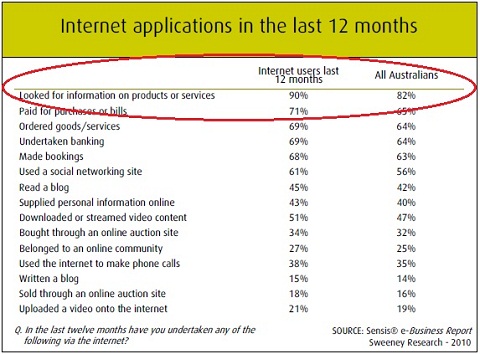
The world of being found is changing quickly. For years now the phone books were a 'must' for businesses of all types, now we're all moving online at an astonishing rate. According to Nielsen, 80.1% of Australia’s population were online in 2010 (= 17.03 million people). A recent Sensis report claimed that 90% of Australian internet users used the internet to look for information on products or services.


Taking into consideration Google’s 94% market share in Australia, we can deduce that 14.41 million Australians have used Google in 2010. That’s almost 68% of the entire Australian population. No other site has this kind of penetration! This represents a rapid growth over the last three years. In fact the latest trend points to a huge increase in using mobile phones for searching for businesses and services, an area Google very keen to expand quickly, and for good reason. A recently published statistics indicate that 41% of all mobile phone users in Australia access the web, with searching for products and services listed as the 4th most popular activity at 56% which represents a 15% increase over the previous year.
Organise Internet has been in THE SEARCH BUSINESS for many years and our accumulated experience is reflected in our mature and practical approach to online developments. Our deep knowledge of other Google products and services really helps navigate this relatively new area of business marketing. So if you're looking at getting found by the people who want to find you, talk to us. We're not script kiddies or back room operators, we know a lot about search and we're happy to help you get the results you're looking for.

Email David or Danis or call us on (02) 4340 5706 and book a low cost briefing session. We're bound to surprise you about the possibilities for those that adopt a flexible mature approach.
© Copyright Organise Internet